

GE Air Conditioner Remote Control Manual: A Comprehensive Guide
This manual details operation, troubleshooting, and replacement options for your GE air conditioner’s remote (AKB73795706), ensuring convenient climate control.
Understanding Your GE Air Conditioner Remote
Your GE air conditioner remote is the primary interface for controlling your unit’s functions, offering convenient adjustments without needing direct access to the appliance itself. It allows for precise temperature settings, mode selection (cooling, heating, fan, auto), and fan speed adjustments. The remote utilizes infrared technology to communicate with the air conditioner, requiring a clear line of sight for optimal performance.
Understanding the layout and functionality of each button is crucial for maximizing your comfort. While the GE app offers some control, the remote provides dedicated, immediate access to all core features. A malfunctioning remote, with unresponsive buttons or physical damage, can significantly impact usability, necessitating troubleshooting or replacement. Remember it requires two AAA batteries for operation.

Remote Control Model Numbers & Compatibility
The primary remote control model number for many GE air conditioners is AKB73795706. However, compatibility can vary depending on the specific air conditioner model. While this remote is widely used, it’s essential to verify compatibility before purchasing a replacement. Some GE units may utilize slightly different remotes, though universal remotes with learning capabilities often offer a solution.
Checking your air conditioner’s original documentation or contacting GE customer support are the most reliable ways to confirm the correct remote model. Online retailers, like Amazon, often list compatible models in their product descriptions. Be aware that simply matching the model number doesn’t guarantee functionality; always double-check for confirmed compatibility to avoid purchasing an unsuitable remote.
Battery Installation & Replacement
Your GE air conditioner remote requires two AAA batteries for operation. To install, locate the battery compartment, typically on the back of the remote. Slide off the compartment cover, observing the polarity markings (+ and -) inside. Insert the batteries accordingly, ensuring correct alignment. Replace the cover securely.

When the remote’s performance diminishes – reduced range, unresponsive buttons – it’s time for battery replacement. Use fresh, high-quality AAA batteries for optimal performance. Avoid mixing old and new batteries, or different battery types. Regularly check battery levels, especially during peak usage seasons. Proper battery maintenance ensures consistent and reliable control of your air conditioning unit.
Basic Remote Button Functions
The GE air conditioner remote provides intuitive control over your unit’s settings. The Power button turns the unit on and off. Mode Selection allows you to choose between Cool, Heat, Fan, and Auto operations, tailoring the climate to your needs. Temperature Adjustment buttons increase or decrease the desired room temperature.
Fan Speed Control lets you select from multiple fan speeds – Low, Medium, High, and Auto – for customized airflow. These core functions provide essential control. Familiarizing yourself with these buttons will allow for efficient and comfortable operation of your GE air conditioner. Remember to consult the full manual for detailed explanations of each function.
Power Button Operation
The Power button on your GE air conditioner remote is the primary control for turning the unit on and off. A single press typically activates the air conditioner, initiating the previously selected settings. Pressing the Power button again deactivates the unit, returning it to a standby state.
However, due to potential issues with worn-out buttons, responsiveness can sometimes be inconsistent. If the unit doesn’t respond, ensure fresh batteries are installed. If issues persist, consider exploring replacement remote options. Learning mode on universal remotes might offer a workaround if direct control is unavailable, though accessing on-device controls can be challenging.
Mode Selection (Cool, Heat, Fan, Auto)
Your GE air conditioner remote features dedicated buttons for selecting the desired operating mode: Cool, Heat, Fan, and Auto. The ‘Cool’ mode lowers the room temperature. ‘Heat’ raises it, while ‘Fan’ circulates air without temperature adjustment. ‘Auto’ mode intelligently switches between cooling and heating to maintain a set temperature.
Selecting the appropriate mode is crucial for optimal comfort and energy efficiency. Note that the availability of ‘Heat’ mode depends on your specific air conditioner model. If the remote seems unresponsive, verify battery functionality. If mode selection remains problematic, a replacement remote might be necessary, readily available from online retailers like Amazon.
Temperature Adjustment

The ‘Temp’ or ‘+/-’ buttons on your GE air conditioner remote control allow precise temperature adjustments. Pressing the ‘+’ button increases the set temperature, while the ‘-’ button decreases it. The display will show the selected temperature, typically in Fahrenheit. Many users report difficulty locking the display to Celsius, despite trying various button combinations.
If temperature adjustments aren’t registering, ensure the remote has fresh batteries and is directed towards the air conditioner’s sensor. Some users have abandoned the GE app due to similar control issues. Consider exploring universal remotes or replacement remotes (like those found on Amazon) if consistent temperature control proves elusive.
Fan Speed Control
Your GE air conditioner remote features dedicated buttons to manage fan speed, typically labeled ‘Fan’ or with incremental speed icons. These buttons cycle through available speeds – Auto, Low, Medium, and High – optimizing airflow and comfort. The ‘Auto’ setting adjusts fan speed based on the temperature difference between the room and the setpoint.
Indicator lights on the controller display the current FAN mode. If the fan isn’t responding, verify battery functionality and remote alignment with the unit. While the remote controls core AC functions, auxiliary player operations are limited to volume and source selection. Explore replacement remotes if issues persist, as worn buttons can hinder proper operation.
Troubleshooting Common Remote Issues
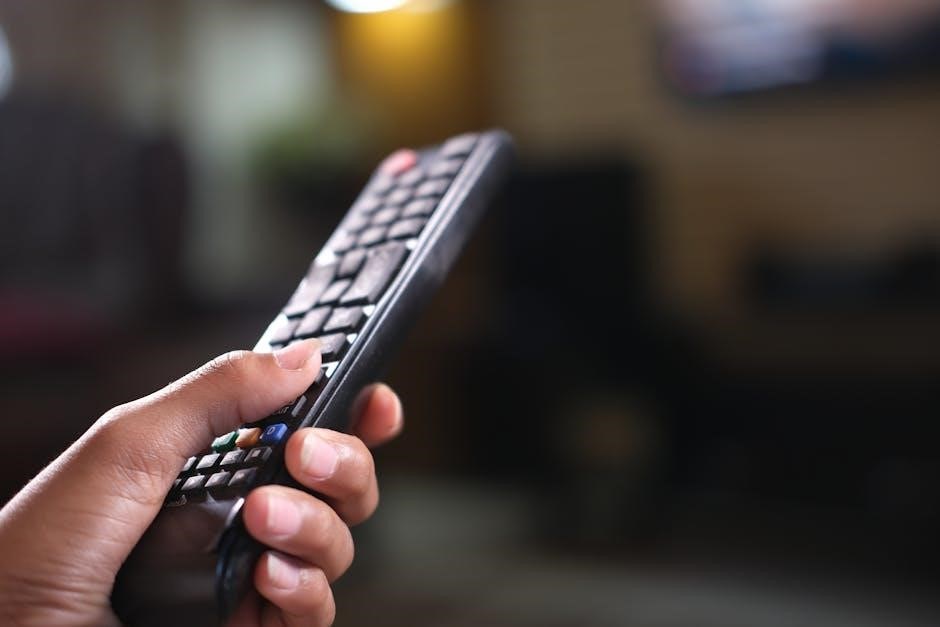
Several issues can arise with your GE air conditioner remote. Unresponsive buttons are frequent, often stemming from depleted batteries or physical damage. First, replace the batteries with fresh AAA batteries. If problems persist, inspect the remote for visible damage – cracks or button wear. A malfunctioning remote may cause inconsistent or delayed responses from the air conditioner.
If the remote isn’t connecting, ensure a clear line of sight to the unit. Try various button combinations (Power + Mode, Temp + Timer) as a potential reset, though Celsius locking remains elusive for some users. Replacement remotes are readily available online, like those found on Amazon, using the manufacturer part number AKB73795706.
Unresponsive Buttons
Experiencing unresponsive buttons on your GE air conditioner remote is a common frustration. The most frequent cause is depleted batteries; always begin by replacing them with fresh AAA batteries. If new batteries don’t resolve the issue, carefully inspect the remote for any physical damage, such as cracks or signs of wear around the buttons themselves.
Worn-out buttons can develop a poor connection. While learning mode or universal remotes offer alternatives, repairing individual buttons is often difficult. Consider exploring replacement remote options, readily available online. Users have reported attempting various button combinations as a reset, but success isn’t guaranteed. A consistently unresponsive remote signals a potential need for replacement.
Remote Not Connecting to Air Conditioner
If your GE air conditioner remote isn’t connecting, several factors could be at play. First, ensure there’s a clear line of sight between the remote and the air conditioner’s sensor – obstructions can interfere with the signal. Verify the remote has fresh batteries, as low power weakens transmission. Attempt resetting the air conditioner by briefly disconnecting it from the power source.
The GE app, while intended for control, has proven unreliable for some users. Explore alternative control methods, like a replacement remote. Learning mode on universal remotes might offer a solution, though compatibility isn’t always assured. If issues persist, a malfunctioning sensor within the air conditioner itself could be the root cause, requiring professional service.
Physical Damage to the Remote
Visible physical damage to your GE air conditioner remote often indicates internal component failure. Cracked casings, broken buttons, or signs of liquid exposure can all disrupt functionality. While attempting to repair a damaged remote is possible, it’s generally not recommended due to the complexity of the internal circuitry and potential safety hazards.
A more practical solution is to explore replacement options. Numerous retailers, including Amazon, offer compatible GE remote controls (like the AKB73795706 model). Consider a universal remote with learning capabilities as an alternative, though programming can be challenging. Prioritize a replacement to restore full control over your air conditioner’s settings and features.
Locking in Celsius Temperature Display
Many GE air conditioner users report difficulty permanently switching the temperature display to Celsius using the remote control. Despite numerous attempts with various button combinations – such as holding Power + Mode or Temp + Timer – the remote often reverts to Fahrenheit. This appears to be a common issue with certain GE models, and the official instruction manual frustratingly lacks specific guidance on this feature.
Users have shared experiences of giving up on the GE app due to its limitations. Currently, there’s no known reliable method to lock the Celsius display solely through the remote. Exploring universal remotes or contacting GE support directly might offer potential solutions, but success isn’t guaranteed.
GE App Limitations & Alternatives
Several users have expressed dissatisfaction with the GE air conditioner app, citing its limited functionality and unreliability as reasons for abandoning its use. The app doesn’t consistently provide solutions for common remote control issues, such as locking the temperature display in Celsius, and lacks comprehensive code databases for universal remote compatibility.
While intended to offer convenient control, the GE app often falls short of expectations. Consequently, users are actively seeking alternative solutions, including exploring third-party smart home integrations or relying on universal remotes with learning capabilities. Sofabaton, a popular universal remote brand, was contacted by a user but currently lacks codes for specific GE models.
Finding Replacement Remote Controls
When your original GE air conditioner remote control (Manufacturer Part Number AKB73795706) is lost, damaged, or malfunctioning, readily available replacements ensure continued ease of use. Online retailers, particularly Amazon, offer a variety of compatible options, such as the replacement listed at https://www.amazon.com/Replacement-Conditioner-Akq06lzg1-AKQ12DNT1-AKQ12ANT1/dp/B0B3TRMDM1.
These replacements aim to restore full control over your air conditioner’s features. Before purchasing, verify compatibility with your specific GE model number. Searching online using the manufacturer part number is a reliable method. Consider exploring options beyond the official GE store to potentially find more affordable or readily available alternatives, maintaining seamless access to your appliance’s functions.
Amazon & Online Retailers
Amazon serves as a prominent source for GE air conditioner remote replacements, offering a diverse selection and competitive pricing. A specific example, found at https://www.amazon.com/Replacement-Conditioner-Akq06lzg1-AKQ12DNT1-AKQ12ANT1/dp/B0B3TRMDM1, demonstrates the availability of compatible units.

Beyond Amazon, numerous other online retailers stock these remotes. eBay often features both new and used options, potentially offering cost savings. When searching, utilize the GE manufacturer part number (AKB73795706) for precise results. Carefully review product descriptions and customer reviews to confirm compatibility with your exact air conditioner model before completing your purchase, ensuring a functional replacement.
Manufacturer Part Number (AKB73795706)
The GE air conditioner remote control carries the manufacturer part number AKB73795706. This number is crucial when searching for a replacement, ensuring compatibility with your specific air conditioning unit. Utilizing this part number streamlines the search process across various online retailers and with GE’s customer support.
This remote is designed for adjusting air conditioner settings and requires two AAA batteries for operation. Identifying a malfunctioning remote often presents as unresponsive buttons or a delayed response from the air conditioner. Knowing the part number simplifies ordering a correct replacement, restoring full control over your appliance’s functions and maintaining convenient operation.
Learning Mode & Universal Remotes
Exploring learning mode or utilizing a universal remote presents potential solutions when the original GE remote (AKB73795706) is lost or malfunctioning. However, successfully programming a universal remote for this specific GE model can be challenging, as direct codes are often unavailable in standard databases, like those offered by Sofabaton.
Users have reported difficulty finding compatible codes within universal remote apps, necessitating a potentially cumbersome learning process – copying signals from the original remote. This process is complicated by the physical accessibility of the air conditioner’s on-device controls. While possible, it requires patience and may not replicate all functions perfectly. Consider replacement remotes as a more straightforward alternative.
Auxiliary Control Limitations
The supplied GE air conditioner remote control (AKB73795706) offers limited functionality regarding auxiliary player operations. Specifically, control is largely restricted to volume adjustment and source selection when connected to external devices.
Beyond these basic functions, the remote does not extend comprehensive control over auxiliary players. Users should not expect to manage playback, navigate menus, or access advanced features of connected audio or video equipment directly through the GE remote. This design prioritizes core air conditioning controls, acknowledging the specialized nature of auxiliary device management. Therefore, dedicated remote controls for auxiliary devices are recommended for full operational control.
Remote Control Cable Types (M-NET)
Regarding connectivity, GE air conditioners utilize specific remote control cable types, notably the M-NET cable. This cable facilitates communication between the indoor unit and certain remote control systems, enabling advanced features and control capabilities.
M-NET cables are designed for reliable data transmission, ensuring accurate command execution from the remote to the air conditioner. While the standard infrared remote is common, M-NET provides a more robust connection for specific models or functionalities. Understanding the cable type is crucial during installation or when replacing components. Proper connection ensures optimal performance and avoids compatibility issues. Further technical details regarding M-NET specifications can be found in the service manual.
Controller Indicators & FAN Mode
The GE air conditioner remote features indicator lights that display the current operational status. These lights signal power, mode selection (Cool, Heat, Auto), and fan speed. Pay attention to these indicators for quick status checks without needing to observe the unit directly.
Specifically, the FAN mode controls the air circulation without heating or cooling. Utilizing FAN mode allows for consistent airflow, improving air quality and comfort. The remote’s FAN speed buttons adjust the intensity of this circulation. Indicator lights will confirm the selected fan speed. Proper understanding of these indicators and FAN mode functionality enhances user experience and optimizes air conditioner performance. Refer to the remote’s labeling for specific indicator meanings.
Remote Control Shielding Wire (CVVS)
The CVVS wire within the GE air conditioner remote control serves a crucial function: electromagnetic interference (EMI) shielding. This specialized wire minimizes signal disruption, ensuring reliable communication between the remote and the air conditioning unit. Without adequate shielding, external electronic noise could interfere with the remote’s signals, leading to erratic behavior or complete non-responsiveness.
CVVS, denoting a specific wire construction, is designed to contain and redirect unwanted electromagnetic radiation. Maintaining the integrity of this wire is vital for consistent remote operation. Damage to the CVVS wire, often due to bending or stress, can compromise its shielding capabilities. Inspecting the wire during troubleshooting can help identify potential causes of remote control issues, particularly intermittent connectivity problems.
Allowable Number of Controllers
Generally, GE air conditioning units are designed to operate with a single remote controller. While the system might technically recognize multiple remotes transmitting signals, only the last transmitted command is typically processed, creating unpredictable behavior. Attempting to use several remotes simultaneously can lead to conflicting instructions and a malfunctioning air conditioner.
The internal receiver prioritizes the most recent signal received, effectively ignoring others. This design prevents accidental or unintended adjustments from different users. Though not officially supported, some users explore using universal remotes programmed with the GE code, but consistent performance isn’t guaranteed. Relying on the original, or a direct replacement, remote ensures optimal control and avoids potential compatibility issues.